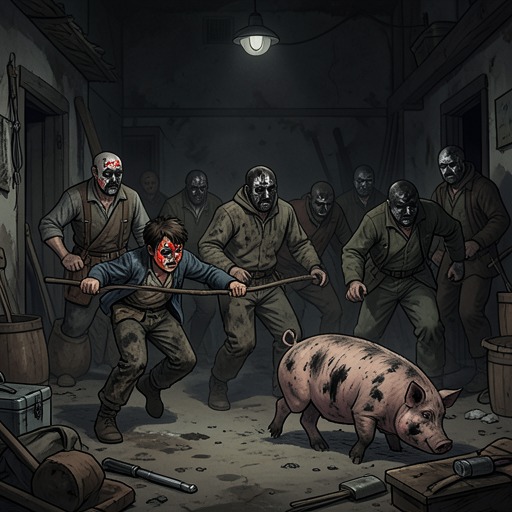
Wild boar
Lord of the FliesWild boar are both a source of food and the focus of a hunt that turns into a display of the boys’ growing violence. The killing of a sow provides Jack’s hunters with meat, but its drawn-out pursuit and slaughter also lead to a ritual offering to the beast, bringing the boys’ fear and their own capacity for brutality into close contact.
The Hunt and the Sow
After the boys have seen what they take to be the beast on the mountain, Ralph doubts that they could fight a creature of such size. Jack, however, turns attention to his hunters and leads them into the forest. He finds scattered roots that indicate a pig has been feeding nearby, then discovers a group of pigs resting beneath trees. The chosen animal is the largest sow, lying apart with piglets sleeping and burrowing beside her. That maternal setting makes the attack more than a practical search for food: the hunters single out a mother among her young.
From close range, the boys throw wooden spears hardened in fire. One piglet runs screaming into the sea with Roger’s spear trailing behind it, while two spears strike the sow’s flank. She escapes the first rush, and the tangled forest allows her to keep ahead of the pursuing hunters. Jack follows drops of blood and signs in the trees, leading the others after her. As the afternoon wears on, she bleeds and stumbles while the hunters stay close, drawn onward by the chase. She finally falls in an open space under the heat. Jack stabs down with his knife; Roger presses his spear into her, and the sow’s terrified squealing ends when Jack finds her throat. The hunters emerge from the chase not simply with a carcass, but with the excitement of having pursued and overwhelmed a living animal.
The Kill Becomes a Gift
The sow’s death is followed by play that makes the violence feel communal and rehearsed. Jack Merridew holds out his bloodied hands for the others to see, then smears the blood across Maurice’s cheeks. The hunters laugh as they repeat the attack in crude pantomime: Robert’s joke about Roger’s spear is echoed by Robert and Maurice acting out the pig’s struggle to escape it. Once the laughter subsides, Jack Merridew turns from performance to butchery, paunching the sow and piling her guts on a rock while the boys watch. The carcass is meat, but the group has also made its pursuit and killing into a shared spectacle.
The practical need for a fire exposes the new tribe’s dependence on what it has left behind. Jack Merridew plans to carry the meat to the beach, invite the other boys to a feast, and have four hunters raid the camp for fire. He assigns Roger to take a burning branch while he speaks to the others; the meat and the anticipated feast thus become part of a plan to draw boys away from Ralph’s authority. Before the group leaves, Jack Merridew has Roger sharpen a stick at both ends. The sow’s head is forced down over its point and fixed in a crack in the rock, with blood running along the stick. Jack Merridew announces that it is a gift for the beast. The hunters fall quiet, then hurry away, leaving the head and the bloody remains behind.
Simon remains concealed among the leaves after the others have fled. The pig’s head persists in his sight like an after-image; he looks away, shuts his eyes, and tries to make sense of the gift and the possibility that the beast might come for it. Flies gather over the head and the spilled guts, while Simon sits in the oppressive stillness until he looks again at its teeth and dim eyes. What the other boys have installed as an offering becomes, for him, a confrontation with a truth they cannot recognize. Later, the Lord of the Flies addresses Simon through the pig’s head and identifies itself as the beast, telling him that the thing he imagines hunting is part of the boys themselves. The scene turns the trophy of a successful hunt into an image of violence that cannot be driven out by killing an animal.
The offering also binds together the fear of the beast and the hunters’ appetite for meat, status, and collective excitement. Earlier, Simon’s suggestion at the assembly that the danger might be within the boys is met with laughter and disorder; now the head gives that fear a physical object, even as its meaning remains hidden from the group. At the later dance in the storm, Ralph and Piggy join the circle around the hunters, and the chant to kill the beast gathers force. In this pattern, the wild boar is first hunted as prey and then made to stand for a threat beyond the hunters’ control. The ritual does not master that threat: it gives the boys’ own violence a target and a ceremony through which to intensify.
The Animal Beneath the Symbol
The sow is first presented not as a monster but as an animal at rest: she lies apart from the other pigs, her piglets asleep or burrowing beside her. The hunters’ choice of this particular prey places ordinary animal life—feeding, shelter, and maternal care—directly in the path of their new purpose. Nothing in the encounter suggests that the sow threatens the boys. The danger attached to her comes from the boys’ fear of the beast and from their own decision to hunt.
The pursuit keeps the animal’s suffering visible rather than allowing the kill to become an instantaneous triumph. Spears lodge in her flank; their trailing ends impede her, and one is driven deeper when she blunders into a tree. The hunters follow the blood through the forest as she struggles to stay ahead, until heat and exhaustion bring her down. This drawn-out passage matters to the meaning of the hunt: the group’s excitement grows alongside the sow’s injury, making its collective exhilaration dependent on a living creature’s prolonged distress.
Afterward, the boys turn the sow’s head into an offering, but the gesture cannot transform the animal into evidence of an actual beast. Its fixed grin and the flies gathering at the remains give the scene a stubborn physical reality: this is a dead animal, while the threat the boys fear remains unlocated. The boar therefore occupies two unequal positions in the story. It is a real creature whose body suffers and supplies food, and it is made to carry a supernatural fear that the hunt cannot resolve. The gap between those positions exposes how readily the boys’ ritual gives a name and an object to terror without understanding its source.
The Hunt Repeated as Ritual
The hunt’s pattern returns in the storm dance, where the boys turn the pursuit of an animal into a collective performance. Roger first plays the pig, grunting and charging at Jack while the others form a ring with spears, spits, and firewood clubs. Then Roger becomes a hunter, leaving the ring’s center empty; some of the youngest boys form another circle of their own. As the chant and stamping grow more regular, the separate groups move like a single body. Ralph and Piggy, frightened by the storm, join in, finding a measure of security in the circle even as its violence intensifies. The sequence shows how the killing of the sow supplies more than food: its roles and gestures can be rehearsed, repeated, and redirected, until the hunt’s imagined prey is no longer an animal.